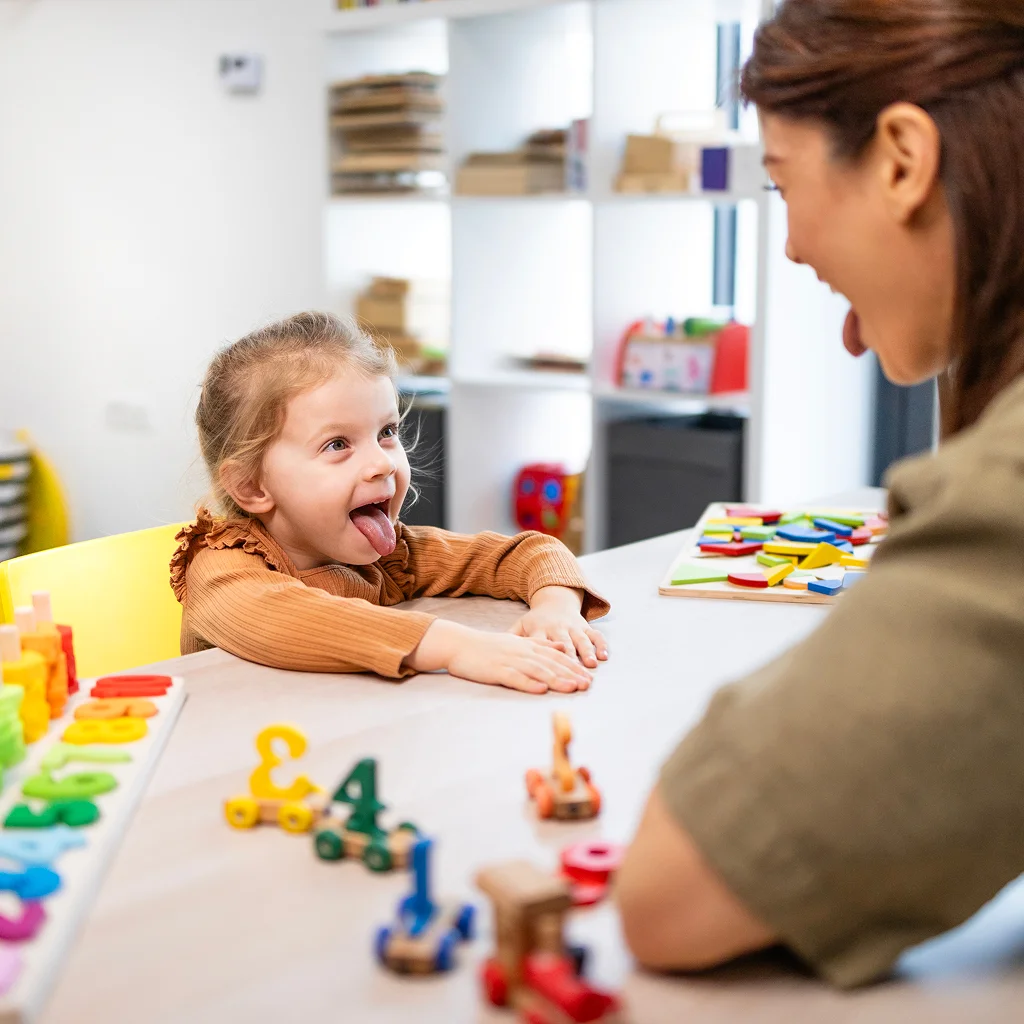

Every child deserves a way to express their thoughts, needs, feelings, choices, and personality. For some children, spoken language may not be the most reliable or accessible way to communicate. Augmentative and alternative communication, often called AAC, gives children additional tools and strategies to connect with the people around them.
At The Clubhouse, we support all forms of communication, including spoken language, AAC, sign, gestures, visuals, and multimodal communication systems. Our speech-language pathologists work with children and families to find communication solutions that are meaningful, practical, and individualized.
Whether your child is just beginning to communicate, has difficulty being understood, or needs a more robust communication system, our team can help you explore AAC in a supportive, play-based environment.
How to Use This Screener
Review each statement below and check the ones that describe behaviors you regularly notice in your child. Consider how they do at home and school, as well as during play, meals, dressing, and other daily routines.
If three or more statements apply, or you have concerns about the intensity of one particular behavior, an occupational therapy screening or evaluation may help you better understand your child’s needs.
Occupational Therapy 5-Minute Screener
As an infant, did the child skip creeping (on hands and knees) or refuse tummy time?
Does the child toe walk much of the time?
Is the child hesitant about reaching across to the other side of his/her body to reach for toys?
Does the infant or child appear or feel ‘stiff’ or ‘floppy’?
Does the child not seem to use two hands together to complete tasks?
Does the child display a short attention span for their age, especially for play or fine motor tasks, or seem to jump from toy to toy?
Does the child seem to have weak hands?
Does the child seem to use inefficient grasps for holding or manipulating toys, especially small items?
Is the child a picky eater, such that nutrition is a concern?
Does the child appear particularly sensitive to temperatures or textures?
Does the child fight face-washing or teeth-brushing?
Does the child resist getting hands dirty or participating in ‘messy’ play?
Does the child have difficulty with transitions or seem over-attached to routines?
Does the child appear to have weak muscles or low endurance for their age?
Does the child seem clumsy, often bumping into objects, dropping things, etc?
Does the child demonstrate poor attention span, focus, or participation at home, school, or in the community?
Does the child seem to not “tune in” to what is being said?
Does the child seem to not understand what is being said?
Does the child seek out, or strongly avoid, certain types of movement, touch, mouthing or biting of objects, or sound play?
Does the child seek out unusual forms of movement, touch, oral, or auditory exploration or play?
Does the child demonstrate repetitive play or echolalic speech (repeating back what has been said)?
Do you have concerns about the child’s ability to feed or dress him/herself?
Is the child extremely particular about what type of clothing he/she will wear, sometimes requiring clothing that is inappropriate for the weather?
Does the child seem to have difficulty making friends, preferring solitary play or interaction with adults?
Does the child avoid eye contact?
Does the child seem to have a significantly decreased awareness of pain or temperature?
Does your child appear unusually sensitive to sounds?
Does the child tend to avoid playground equipment?
Does the child tend to be impulsive, sometimes to the point of concern for safety?
Does the child seem to always be moving or fidgeting?
Does the child easily become frustrated or angry?
Does the child become aggressive for no apparent reason; headbanging, screaming, hitting, etc.?
What Do My Results Mean?
Checking one or more items does not necessarily mean that your child has a developmental or sensory disorder. Many of these behaviors can occur at different points during childhood.
However, several concerns occurring together—or one concern that is significantly affecting your child’s everyday life—may be a reason to speak with an Occupational Therapist.
An OT can take a closer look at areas such as:
- Sensory processing
- Fine and gross motor skills
- Coordination and motor planning
- Attention and participation
- Feeding and mealtime skills
- Dressing and other self-care activities
- Play and social participation
- Strength and endurance
I Checked Three or More Items. What Happens Next?
The next step is simple: reach out to our team. Your child deserves to feel more confident and capable doing the things that are part of growing, learning, playing, and becoming more independent. At The Clubhouse, we provide pediatric occupational therapy at our Downers Grove and North Mayfair, IL, locations. You don’t need to know exactly what kind of support your child needs before you call.
Tell us what you’re seeing at home or at school, and we can start from there.
Have Questions About Your Child’s Development?
If you checked three or more items—or you’re especially concerned about one particular area—contact our team to
discuss your observations and learn more about your options.
What to Expect From an Occupational Therapy Evaluation
If an evaluation is recommended, an Occupational Therapist will look more closely at your child’s individual strengths and challenges. Depending on your child’s needs, this may include observing movement, coordination, sensory responses, play, attention, fine motor abilities, feeding, and everyday self-care skills. Afterward, the therapist can discuss their findings with you and explain whether therapy,
additional monitoring, or another type of support may be helpful.
You Know Your Child Best
A checklist cannot capture everything you observe in everyday life. If something about your child’s movement, sensory responses, feeding, independence, behavior, or participation is concerning you, you do not need to wait until several boxes are checked before asking questions or seeking help.
We can discuss whether your child may benefit from an Occupational Therapy screening, evaluation, or other support. Contact The Clubhouse in Downers Grove or North Mayfair to start the conversation. Together, we can empower your child through collaborative, compassionate care.
This screener is intended as a general informational tool and is not a substitute for a professional evaluation, diagnosis, or medical advice.